
 English
 Spanish
 French
 German
 Italian
 Chinese (Simplified)
 Japanese
 Korean
 Arabic
 Portuguese

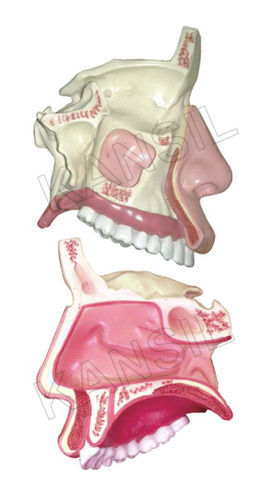
Model of the Anatomical Nasal Cavity Model
Product Details:
- Power Supply Not required
- Control Type Manual
- Display Type Physical model
- Temperature Resistance Up to 50C
- Dimension (L*W*H) Approx. 25 cm x 15 cm x 12 cm
- Power Not required
- Material PVC (Polyvinyl Chloride)
- Click to View more
X
Model of the Anatomical Nasal Cavity Model Price And Quantity
- 1 Box
Model of the Anatomical Nasal Cavity Model Product Specifications
- Up to 50C
- Physical model
- PVC (Polyvinyl Chloride)
- Not required
- Approx. 25 cm x 15 cm x 12 cm
- Not required
- Manual
Model of the Anatomical Nasal Cavity Model Trade Information
- 500 Box Per Day
- 1 Week
Product Description
Details:
- This model helps the students to understand:
- External nose: shows the section of the nasal bones and cartilages
- Nasal cavity: on the lateral nasal wall show the superior, middle and inferior nasal chonchae project medially into the nasal cavity forming the superior, middle and inferior nasal maxillary sinuses
- Para nasal sinuses: shows the frontal, sphenoid and maxillary sinuses
Exceptional Detail for Effective Learning
Designed for academic excellence, this two-part nasal cavity model provides precise anatomical features for thorough understanding. Its universal compatibility ensures it fits seamlessly into any teaching curriculum, supporting both students and healthcare professionals in mastering ENT structures.
Durable and Easy-to-Clean Material
Manufactured from sturdy PVC, the model is built to last and can withstand repeated handling in busy educational environments. Its surface is resistant to disinfectants and can be cleaned with alcohol, making it simple to maintain hygiene after each use.
Versatile Applications and Safe Packaging
Whether used for classroom demonstrations, professional ENT training, or educating patients about nasal anatomy, this model is suited for a variety of educational scenarios. Each piece arrives securely boxed with protective padding to prevent damage during transportation and storage.
FAQs of Model of the Anatomical Nasal Cavity Model:
Q: How is the anatomical nasal cavity model used in educational settings?
A: The model is primarily used for student training, ENT demonstrations, and patient education, allowing users to visually and physically explore the nasal cavitys structures, which enhances comprehension and retention.Q: What steps should be followed to clean and disinfect the nasal cavity model?
A: The model should be wiped with alcohol or a suitable disinfectant to ensure hygiene, as its PVC material is designed to be resistant to cleaning agents and can be safely washed as needed.Q: When is this model particularly beneficial during training or demonstrations?
A: The model is especially useful during anatomy lessons, clinical demonstrations to ENT students, and when explaining procedures or anatomical conditions to patients, providing a tangible visual reference.Q: Where can this nasal cavity model be utilized effectively?
A: It is ideal for use in classrooms, hospitals, clinics, and academic laboratories, and is suitable for any setting that involves teaching or demonstration of nasal anatomy.Q: What are the main advantages of using a physical (non-digital) nasal cavity model?
A: A physical model allows hands-on examination, which aids in spatial understanding of complex anatomy. It is portable, requires no power, and facilitates group demonstrations or individual study without technical limitations.Q: How does the model support universal brand compatibility for academic and scientific institutions?
A: Its design follows standard anatomical conventions and does not require proprietary systems, making it compatible with teaching practices and scientific protocols across a wide range of institutions worldwide.Tell us about your requirement

Price:
Quantity
Select Unit
- 50
- 100
- 200
- 250
- 500
- 1000+
Additional detail
Mobile number
Email

Other Products in 'Human Anatomical Models' category


- N. C. KANSIL & SONS
GST : 07AAAFN3555B1ZP - Kansil Bhawan, 8606, Model Basti,New Delhi - 110005, India
- Phone :08045479865
-



- Key Personnel
- Mr. Alok Kansil (Partner)
- Mobile :08045479865
- nck.digimkt@gmail.com
- WHAT'S APP : (+91-9310512020)
 Send Inquiry
 |
N. C. KANSIL & SONS
All Rights Reserved.(Terms of Use) Developed and Managed by Infocom Network Private Limited. |
