
 English
 Spanish
 French
 German
 Italian
 Chinese (Simplified)
 Japanese
 Korean
 Arabic
 Portuguese

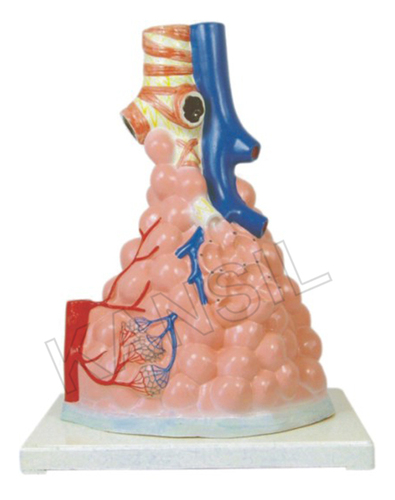
Pulmonary Alveoli Model Magnified Model
200.00 - 1500.00 INR/Box
Product Details:
- Control Type Manual, fixed
- Temperature Resistance Standard classroom conditions
- Display Type 3D Physical Model
- Dimension (L*W*H) Approx. 25 x 18 x 8 cm
- Equipment Materials PVC, Polymeric material
- Power Not required (Manual Model)
- Material High Quality Plastic and PVC
- Click to View more
X
Pulmonary Alveoli Model Magnified Model Price And Quantity
- 100 Box
- 200.00 - 1500.00 INR/Box
Pulmonary Alveoli Model Magnified Model Product Specifications
- Not required (Manual Model)
- High Quality Plastic and PVC
- Manual, fixed
- Approx. 25 x 18 x 8 cm
- PVC, Polymeric material
- Standard classroom conditions
- 3D Physical Model
Pulmonary Alveoli Model Magnified Model Trade Information
- 500 Box Per Day
- 1 Week
Product Description
Details:
- Size: 26 , 15 , 35cm
- Made of PVC plastic
- Mounted on plastic base
- The model shows the small branches of principal bronchus
- Section of bronchiole of no cartilage
- The relation between pulmonary alveoli and terminal bronchiole
- The structure of alveolar sac and alveolar duct
- The capillary rate in the alveolar spat.
Accurate Representation for Enhanced Learning
This magnified pulmonary alveoli model offers an intricately detailed view of lung microstructures, supporting visual and tactile learning. The high-quality materials ensure the model withstands regular handling, making it perfect for classrooms and training sessions. Its realistic design helps clarify concepts of gas exchange, alveolar function, and respiratory health.
Durable, Classroom-Ready Construction
Constructed with robust PVC and premium plastic, the model is built for longevity and repeated educational use. Its stable, fixed base and manual operation require no external power, making setup straightforward. Suitable for standard classroom temperatures, the model remains reliable across varied educational environments.
FAQs of Pulmonary Alveoli Model Magnified Model:
Q: How is the Pulmonary Alveoli Magnified Model used in classrooms?
A: The model serves as an instructional aid to demonstrate alveolar structure and function during biology or medical lessons. Teachers and students can visually and physically explore the features of alveoli, facilitating active participation and clearer understanding of respiratory processes.Q: What materials are used to construct this magnified model?
A: This model is manufactured using high-quality PVC and plastic, ensuring durability as well as accurate anatomical details. The materials are chosen for their sturdiness and suitability for frequent educational use.Q: When should this model be incorporated into educational sessions?
A: Educators typically use the pulmonary alveoli model during lessons on respiratory system anatomy, physiology, or related medical topics to clarify the functions and significance of alveoli in gas exchange.Q: Where is this model most effectively utilized?
A: The model is best suited for classrooms, lecture halls, biology labs, and medical training settings. Its dimensions, durability, and manual operation make it ideal for educational demonstrations and hands-on learning environments.Q: What are the benefits of using a 3D physical alveoli model?
A: By offering a tangible, enlarged visualization of the alveoli, the model helps students and trainees better grasp microscopic lung structures, enhancing retention and comprehension of complex biological functions.Q: How does the model maintain performance under classroom conditions?
A: Designed to be temperature-resistant under standard classroom environments, the high-quality plastic and PVC construction ensures sustained performance without warping or degradation over time.Tell us about your requirement

Price:
Quantity
Select Unit
- 50
- 100
- 200
- 250
- 500
- 1000+
Additional detail
Mobile number
Email

Other Products in 'Human Anatomical Models' category


- N. C. KANSIL & SONS
GST : 07AAAFN3555B1ZP - Kansil Bhawan, 8606, Model Basti,New Delhi - 110005, India
- Phone :08045479865
-



- Key Personnel
- Mr. Alok Kansil (Partner)
- Mobile :08045479865
- nck.digimkt@gmail.com
- WHAT'S APP : (+91-9310512020)
 Send Inquiry
 |
N. C. KANSIL & SONS
All Rights Reserved.(Terms of Use) Developed and Managed by Infocom Network Private Limited. |
